
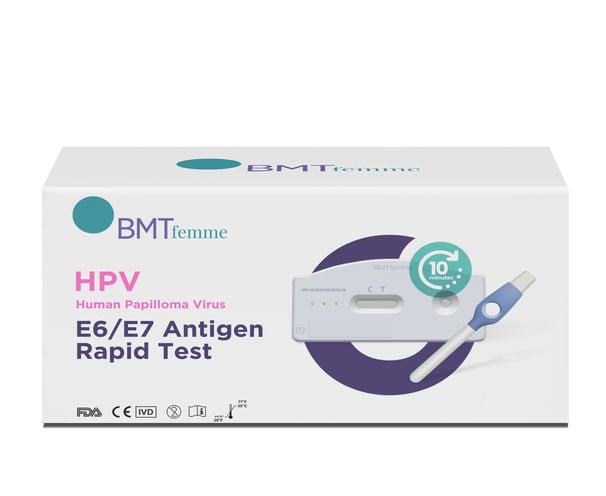
HPV
16/18/31/33/45/52/58
E6/E7 Antigen
Rapid Test with Delphi Collector
The HPV Oncoprotein E6/E7 Rapid Test
has been designed to detect HPV
16/18/31/33/45/52/58 E6&E7 oncoproteins through
visual interpretation of color development in
internal strip.

Oncoprotein Detection with
7 HR HPV Antibodies
The membrane on the cassette is immobilized
with monoclonal anti HPV 16/18/31/33/45/52/58
antibodies on the test region.

Point of care triage for
immediate colposcopy
HPV 16/18/31/33/45/52/58 genotyping with E6/E7 has been recommended to triage for immediate colposcopy in many screening guidelines.
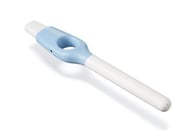
Delphi Self-Collection Lavage
Self-collection by women – The round top is smooth and glides easily into the vagina reducing the possibility of micro‐lesions and infection. No speculum is needed.98% patient satisfaction review for over 1 million women.
The Delphi self-sampling technology offers a comfortable and painless way to collect vaginal samples using a unique lavage method.
Painless and Comfortable
No Speculum Needed
98% Patient Satisfaction
Used by 1 Million Women

Self-collection by women – The round top is smooth and glides easily into the vagina reducing the possibility of micro‐lesions and infection. No speculum is needed.98% patient satisfaction review for over 1 million women.
The Delphi self-sampling technology offers a comfortable and painless way to collect vaginal samples using a unique lavage method.
Painless and Comfortable
No Speculum Needed
98% Patient Satisfaction
Used by 1 Million Women
Delphi Self-Collection Lavage
Frequently asked questions
Why did you chose those genotypes only?
The most common high-risk HPV genotypes associated with the development of cervical cancer are HPV-16 and HPV-18, which are responsible for about 60-70% of cervical cancer cases. Other high-risk HPV genotypes include HPV-31, HPV-33, HPV-45, HPV-52, HPV-58 covers 15-20% of all cases so we will cover nearly 90% of cervical cancer cases on a global basis.
If HPV positive to any other genotype test will be negative?
While the answer to this question may appear definitively as no, considering the types of HPV we cover and their percentages, it may not be clinically meaningful. This is because the activation of E6 and E7 by the remaining 10% of HPV types is quite low, almost approaching impossibility. It will likely be perceived as a temporary infection.
High-risk types of HPV typically contain E6 and E7 oncogenes, and the activation of these oncogenes can contribute to the development of cancer in cells. However, low-risk types of HPV or specific high-risk types may not contain or express E6 and E7 oncogenes to a low extent. In such cases, even though the test result may appear negative, there is a high probability that the infection is temporary or low-risk.
If a patient is HPV positive but there are no E6-E7 than test will be negative?
If someone is HPV positive but tests negative for E6 and E7 genes, it may indicate that the specific high-risk types of HPV associated with those genes are not present. However, it’s essential to note that there are multiple high-risk types of HPV. Testing negative for E6 and E7 genes does not necessarily mean the absence of all high-risk types. The presence of high-risk human papillomavirus (HPV) is typically determined through testing for the DNA of the virus. The E6 and E7 genes are known oncogenes associated with the high-risk HPV types, and their presence is often associated with an increased risk of developing cervical cancer. (CIN1-2-3)
Where to position of E6/E7 to detect precancerous lesions CIN2 and CIN3?
The E6 and E7 oncoproteins are involved in the pathogenesis of HPV-associated cancers, particularly cervical cancer. The E6 oncoprotein binds to the tumour suppressor gene p53, inhibits DNA repair, inhibits apoptosis, and destabilizes the chromosome. The E7 oncoprotein binds to the retinoblastoma protein and promotes dysregulation of the cell cycle. The detection of E6 and E7 oncoproteins targeting HPV16/18 or HPV16/18/31/33/35/45/52/58 can be a promising triage strategy for managing HPV-positive women.